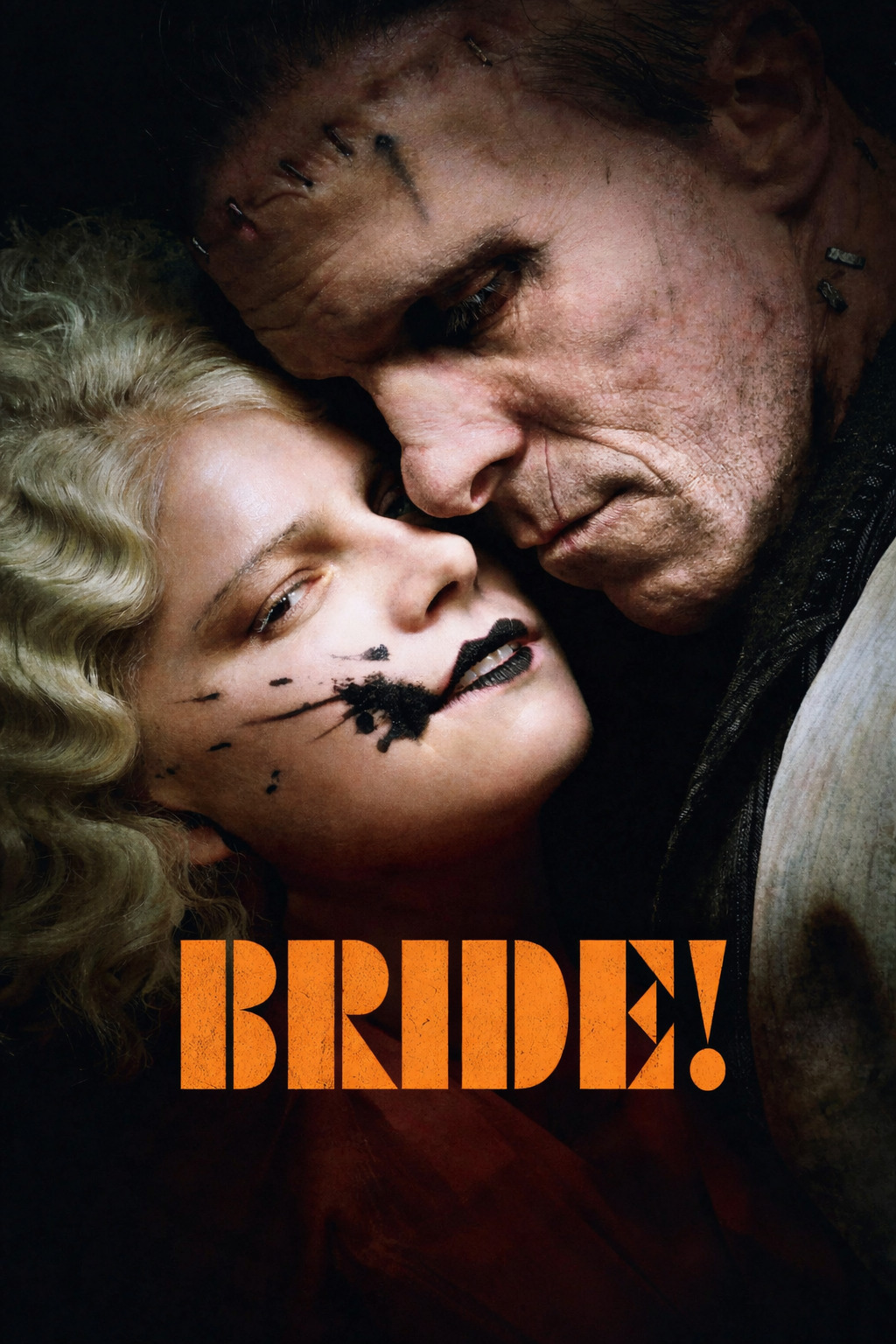
The Bride Was Announced as Horror but Built as Something Else
With a major studio behind it — Warner Bros. — a director whose work signals control rather than compromise — Maggie Gyllenhaal — and a cast defined by presence...
With a major studio behind it — Warner Bros. — a director whose work signals control rather than compromise — Maggie Gyllenhaal — and a cast defined by presence rather than visibility — Christian Bale and Jessie Buckley — the film did not need to prove its importance.
It was assumed.
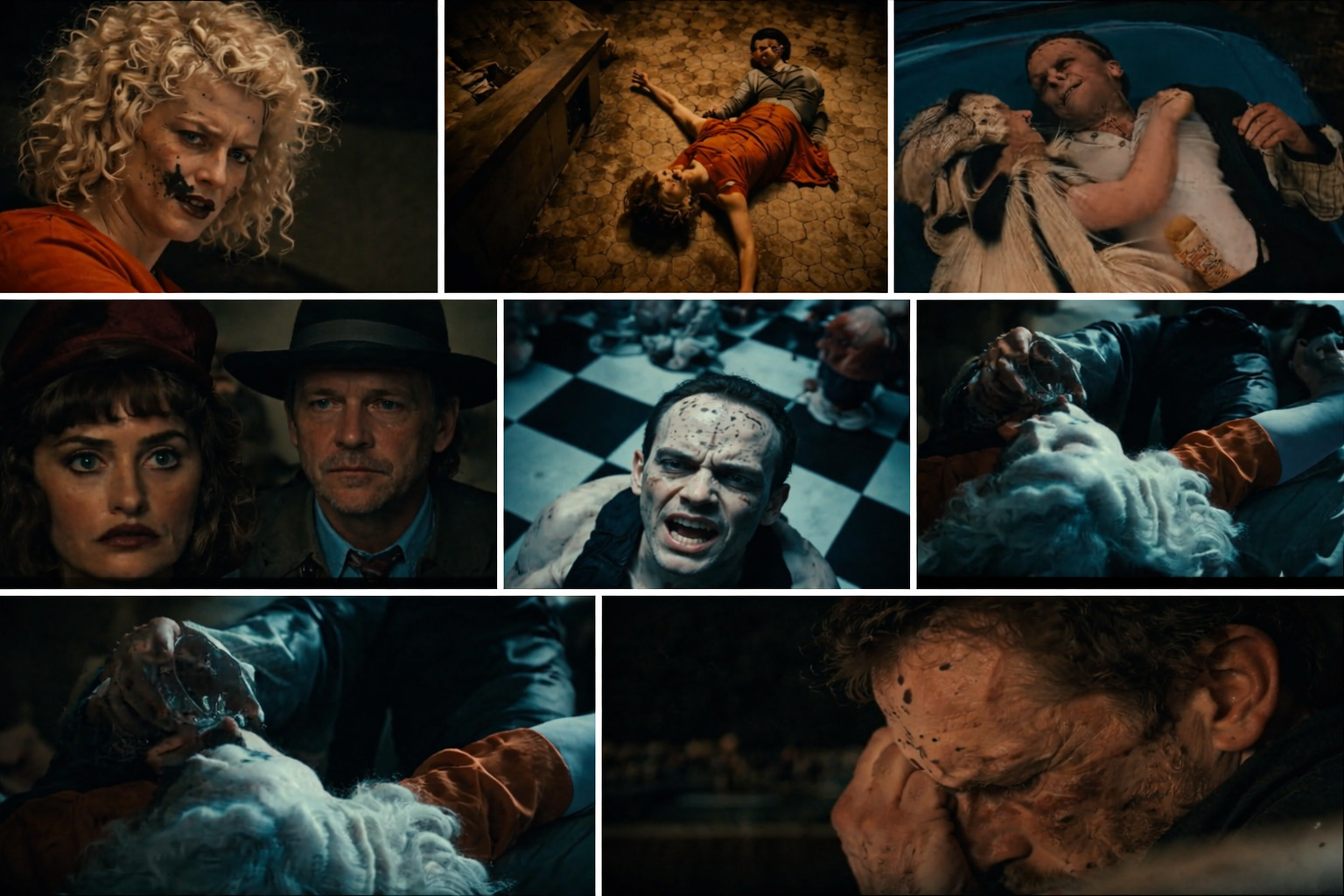
Because the clearer a film signals seriousness, the more rigorously it is measured — not by intention, but by alignment.
Not a Horror Film but a Refusal of Horror
From its opening movement, The Bride positions itself in direct opposition to the genre it appears to inhabit.
Where most reinterpretations of Bride of Frankenstein are engineered around fear as a delivery system — calibrated scares, controlled release, audience response — this version removes fear as a functional mechanism altogether. It does not operate through threat. It operates through inevitability.
That distinction is not cosmetic. It rewires the film at the level of structure.
The central experiment — traditionally staged as rupture, spectacle, the moment where the film “turns on” — is deliberately flattened. There is no ignition point, no operatic reveal, no cinematic payoff designed for reaction. The act of creation passes almost procedurally, stripped of climax, as if the film refuses to acknowledge its own most marketable moment.
Creation is not the climax.
It’s the irreversible state the film unfolds from.
From that point onward, the story does not escalate — it accumulates. The tension is not driven by set-pieces or reversals, but by a slow, tightening awareness that what has been done cannot be undone, reframed, or contained. This is not horror as stimulus. It’s closer to slow-burn existential dread, the kind that doesn’t spike — it lingers and compounds.
In industry terms, the film rejects “payoff logic.” There are no clean beats, no engineered crescendos, no audience-friendly release valves. It denies the viewer the basic contract of the genre: setup, scare, relief.
Instead, it replaces that contract with endurance.
The pacing resists compression. Scenes run past their functional endpoint. Silence is not used as atmosphere, but as pressure. Time is not edited for momentum — it is allowed to pool, to thicken, to sit uncomfortably in the frame.
And that’s where the friction begins.
Because once fear is removed, immediacy disappears with it. Without immediacy, there is no quick access point, no emotional shortcut. The audience cannot “plug in” to the film in the usual way.
It doesn’t ask for engagement.
It asks for endurance.
Not reaction — presence.
The Central Misalignment
The reaction to early test screenings did not emerge from failure.
It emerged from misalignment.
A film positioned within the language of horror delivered something closer to controlled psychological construction — a study of authorship, body, and imposed identity.
And those two experiences are not interchangeable.
Horror invites participation.
This film withholds it.
It does not offer the viewer distance from the monster. Instead, it collapses that distance, redistributing responsibility across every figure within the frame — including the one watching.
This is not a comfortable structure.
And it rarely tests well.
The Monster Is No Longer the Centre
One of the film’s most decisive shifts lies in how it treats the figure traditionally placed at its core.
The monster — embodied by Christian Bale — is no longer constructed as a singular event. There is no defining emergence, no stabilising reveal that locks the narrative into place.
Instead, he is diffused across the film — not as a fixed character, but as a shifting presence that resists clear definition.
What takes shape is not a figure, but a condition: something produced as much by those who created him as by what he becomes. Monstrosity is no longer contained within a body. It is distributed across relationships, decisions, and structures that made that body possible.
The film doesn’t isolate the monster.
It implicates the system that produced him.
And systems are harder to locate, harder to simplify — and, crucially, harder to agree on.
The Bride as Interruption, Not Resolution
If earlier versions framed the Bride as completion, this film dismantles that logic entirely.
Jessie Buckley does not play her as an answer, but as a rupture. Her presence does not resolve the narrative — it destabilises it.
She is neither partner nor object of desire. She exists as a point of tension: between autonomy and design, identity and imposition. Not a character that completes the story, but one that exposes the violence required to construct it.
And that shift is structural.
Once the Bride is no longer an endpoint, the film loses its ability to close. There is no symmetry, no narrative resolution to fall back on — only an open system that continues to unfold beyond the frame.
Precision at the Level of Form
At the level of craft, The Bride appears almost immaculately controlled.
Its material world is built on deterioration rather than polish. Surfaces weaken. Fabrics collapse. Light erodes rather than reveals. Everything feels assembled rather than designed.
And that principle extends into structure.
The rhythm resists acceleration. Scenes extend beyond function. Silence is not used as pause, but as pressure.
Time does not move forward.
It accumulates.
Where the Film Begins to Fracture
It is precisely within this level of control that the film reveals its limitation.
Its form is more stable than the meaning it carries.
The atmosphere is sustained with precision, but it does not consistently convert into shared interpretation. Instead of consolidating around a dominant idea, the film opens into multiple readings — all coherent, all defensible, but none decisive.
It can be read as a study of authorship.
As a reflection on bodily autonomy.
As an examination of the violence embedded in creation itself.
These interpretations coexist, but they do not converge.
And in the current landscape — where consensus drives both critical momentum and audience reception — that lack of convergence becomes structural, not incidental.
Why the Delay Was Inevitable
The decision by Warner Bros. to delay the film was not simply reactive.
It was structural.
A film like The Bride cannot be released without redefining how it is seen. It cannot be sold as horror without creating false expectation. It cannot be simplified without breaking its internal logic.
So the adjustment becomes necessary.
Not to change the film —
but to change the conditions of its reception.
A Film That Refuses to Resolve
What becomes increasingly clear is that The Bride is not interested in closure.
It does not reconcile.
It does not restore order.
It does not offer resolution.
It remains inside consequence.
And that is a far more unstable position.
Because stories that resolve can be shared easily.
Stories that remain open cannot.
They require time.
They require return.
They resist agreement.
What Remains
There is a version of this film that would have arrived earlier.
It would have been clearer, faster, more legible.
It would have delivered fear where fear was expected, and resolution where resolution was required.
It would have worked.
But it would not have lingered.
What The Bride appears to be becoming instead is something more difficult — a film that does not reduce itself in order to be immediately understood, allowing its meaning to remain in motion rather than fixed.
Because cinema does not endure through agreement.
It endures through what remains unresolved.
And in The Bride, nothing is fully resolved.
Not the body.
Not the story.
Not even the idea of creation itself.
And that is precisely why it may last.