Frankenstein Was Taken Seriously but Never Fully Believed
There are films that arrive at the Oscars fighting for recognition, and there are those that arrive already carrying it. Frankenstein belonged unmistakably to t...

There are films that arrive at the Oscars fighting for recognition, and there are those that arrive already carrying it. Frankenstein belonged unmistakably to the latter. With a reported budget of around $120 million, a literary foundation embedded in cultural consciousness, and a director like Guillermo del Toro — whose work has consistently elevated the figure of the “monster” into something deeply human — the film did not need to prove its importance. It was assumed.
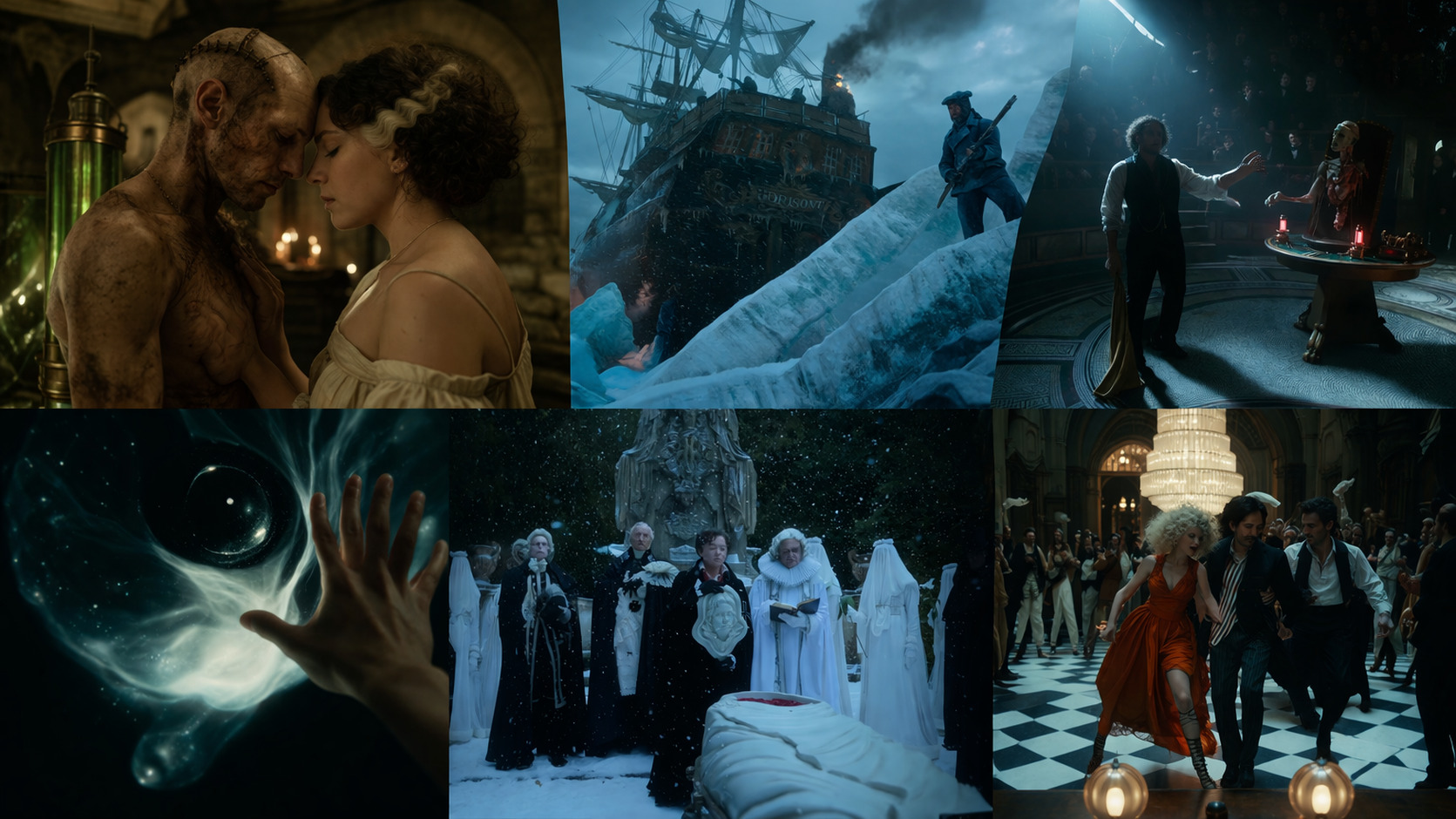
And that assumption shaped the way it was received.
Because the more clearly a film signals that it deserves to be taken seriously, the more rigorously it is tested — not for its intention, but for its ability to hold under scrutiny.
Del Toro has long approached Frankenstein not as a horror story, but as a study of emotional exile — a narrative about what it means to be brought into existence without ever being accepted into it. In his reading, the creature is not the source of fear; it is the consequence of a failure to recognise and take responsibility for life once it has already begun. That idea defines the film, but it also defines its risk. By refusing to build the story around fear, the film removes the most immediate point of entry for the audience. It asks not for reaction, but for endurance.
This becomes most visible in the film’s most radical structural decision.
Where most adaptations build toward the act of creation as a moment of rupture — the point where order breaks and the narrative ignites — del Toro does the opposite. He deliberately displaces that centre. The act of creation is not staged as spectacle or climax; it passes with a strange, almost procedural quietness. What follows is what matters: the irreversible weight of what has already been done, and the slow, inescapable recognition that there is no way to return to a previous state.
In this framework, the creature is no longer an event.
It is a condition.
And that shift changes everything. The film does not move toward a single defining moment; it expands outward into duration. Tension is not produced through escalation, but through accumulation — through the growing awareness that the real catastrophe is not creation itself, but the absence of responsibility that follows it. This is a far more demanding structure, because it removes the stabilising logic of a traditional arc. The film does not guide the viewer toward resolution. It leaves them inside an unfolding consequence.
At the level of craft, however, Frankenstein is almost immaculat.ely controlled
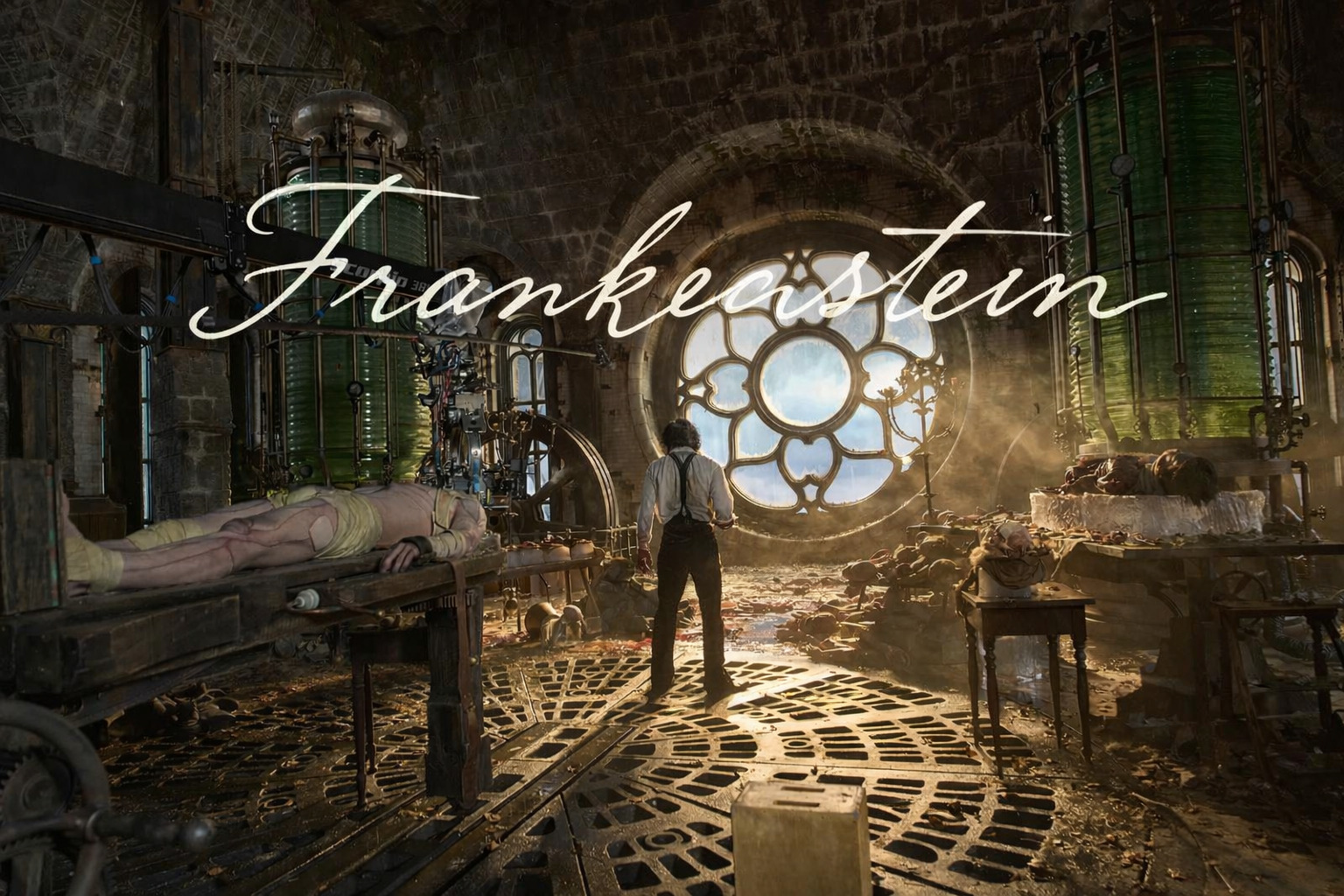
The prosthetic work is among the most intricate of the year — layered, physical, deliberately resistant to digital polish. The body of the creature is not designed to be visually clean or symbolically neat. It is assembled, uneven, carrying weight and imperfection in every frame. As one of the lead artists described during the awards circuit:
“We wanted the body to feel assembled, not designed.”
That principle defines the film’s entire material world.
The costumes follow the same logic, refusing to function as static representations of period. Instead, they are built to deteriorate. Fabrics lose structure, colour drains, silhouettes collapse under the pressure of time and use. Clothing does not preserve identity — it reveals its erosion. Time in Frankenstein is not marked through narrative cues; it is embedded into the physical decay of objects. The world does not remain intact. It visibly weakens.
It is precisely here that the film reaches its highest level of precision — and quietly exposes its own limitation.
It holds flawlessly as construction, but less steadily as meaning; the form is more controlled than the idea it carries.
This imbalance is not immediate, but once it surfaces, it begins to shape the entire perception of the film — and becomes most visible in the central performance.
Jacob Elordi’s transformation was one of the most discussed aspects of the film’s production — hours in the makeup chair, physical endurance, a complete submission to the demands of the role. Yet what appears on screen resists the logic of transformation as spectacle. The performance is not built around a defining scene or emotional peak. It unfolds through hesitation, through incomplete gestures, through a refusal to stabilise into a single, readable identity.
The creature is designed not to resolve. That ambiguity gives it depth, but also limits its reach: what cannot be clearly defined is difficult to share, and even harder to agree on.
Because ambiguity resists compression, and compression is what awards systems depend on. Performances that can be reduced to a moment travel more easily — across clips, across conversations, across votes. A performance that requires time and sustained attention does not convert as efficiently into consensus.
Where the Score Reveals the Fracture
A similar imbalance runs through the score, which often elevates moments the film itself does not fully sustain.
Alexandre Desplat’s composition deliberately avoids the expected language of horror, moving instead toward restraint and distance. Drawing on classical textures, it suggests reflection rather than fear. As music, it is precise — even elegant. Within the film, however, it occasionally lifts scenes beyond what the narrative can fully carry, exposing a quiet but persistent gap. It’s the kind of scoring that feels right in isolation, but slightly out of phase once it locks into picture — not wrong, but not fully aligned either.
Precision Without Convergence
This is not a problem of composition, but of cohesion. The elements are individually precise, yet they do not fully converge into a single, stable whole — and in a film built on such control, even a minor divergence becomes immediately perceptible. By the time Frankenstein reached the Oscars, that divergence had already defined its position: it would be recognised, it would be awarded, but it would not become central.
Recognition Without Elevation
The wins it secured — Costume Design, Makeup and Hairstyling, Production Design — were never in doubt. They reflect the film’s most undeniable strengths, areas where precision is visible and does not require interpretation.
These were confirmations, not elevation. What proved more revealing was its absence elsewhere — not a question of quality, but of alignment. In the current Oscars, excellence alone does not carry a film; what matters is whether it can sustain a shared reading across its audience.
What becomes increasingly clear — especially after watching the trailer — is that Frankenstein is not interested in monsters as mythology, but in monsters as a contemporary condition. The film may be set within a historical frame, but its logic feels unmistakably modern. The horror no longer comes from the existence of the creature itself, but from the world that surrounds it — a world shaped by power, control, and the quiet normalisation of violence.
The shift is subtle, but decisive. The monster is no longer the exception within the story. It begins to read as a product of the same system that rejects it. In that sense, Frankenstein moves away from gothic tradition and toward something closer to a contemporary manifesto, where the boundaries between creator and destroyer collapse, and responsibility is no longer located in a single figure, but dispersed across an entire structure.
This is where the film expands beyond adaptation. It is no longer simply retelling a familiar narrative — it is reframing it. What once belonged to myth begins to resemble reality, and the distance that traditionally protected the viewer starts to disappear. The discomfort no longer comes from what is strange, but from what feels recognisable.
That reinterpretation is carried not only through structure, but through performance. The casting avoids excess and spectacle, leaning instead into presence and control. Each actor brings a sense of weight, as if the characters extend beyond the frame, grounded in something more than narrative function. The performances remain restrained, often deliberately held back, which prevents the film from slipping into theatricality and instead anchors it in something more unsettling.
Because the most effective moments are not those that emphasise the creature, but those that make everything around it feel disturbingly familiar.
The Problem of Agreement
A winning film must not only be strong — it must hold a consistent meaning across a fragmented audience, allowing different viewers to arrive at the same conclusion, even if they take different paths to get there.
Frankenstein does not do that.
It generates multiple readings, each valid and sustained, but none dominant. For some, it is a film about control; for others, about abandonment; for others still, about the impossibility of recognition itself. These interpretations coexist, but they do not converge.
And in the current system, convergence is decisive.
In today’s Oscars, films don’t win because they are the most ambitious — they win because they are the most agreed upon.
A Film That Refuses to Close
This is why the film feels both accomplished and incomplete within the awards landscape. It commands respect through its craft and intention, but it does not resolve into a single, shared interpretation that could carry it to the centre.
And yet, this may ultimately be its greatest strength.
Because there is another measure of cinema — one that does not depend on immediate agreement, but on the duration of thought it leaves behind.
In that sense, Frankenstein operates differently from many of its contemporaries. It does not close itself or offer a final position that can be easily absorbed and repeated. Instead, it remains open, unstable, unresolved — continuing to unfold after the film itself has ended.
What Remains Unresolved
There is a version of this story where Frankenstein wins everything.
But that version would require the film to become simpler than it is.
What del Toro has made instead is something more difficult — and, perhaps, more lasting. A film that does not reduce itself in order to become central, allowing its meanings to remain in motion rather than fixed.
The films that define a season deliver conclusions. The films that define cinema leave something unresolved.
In the end, nothing in Frankenstein remains entirely whole.
Not the body.
Not the world.
Not even the story itself.
And that is precisely why it lingers.
Because the films that define a season are remembered for what they conclude.
But the films that define a filmmaker — and sometimes an era — are remembered for what they refuse to resolve.
Beyond the Result
What Frankenstein ultimately reveals is not a failure to win, but a mismatch between what the film asks for and what the system rewards.
The Academy, as it functions today, is built around convergence — around films that can stabilise meaning across a wide and fragmented body of viewers. It favours works that reduce complexity just enough to become legible in the same way, regardless of who is watching.
Frankenstein moves in the opposite direction.
It does not simplify its ideas in order to travel further. It allows them to remain open, unstable, and at times unresolved — not as an oversight, but as a condition of how the film thinks. It does not guide the viewer toward a single conclusion. It leaves space for multiple ones, even when that space prevents consensus.
And that difference matters.
Because there is a form of cinema that succeeds within a season, and another that continues beyond it. One resolves quickly, the other lingers. One is built to be agreed upon, the other to be returned to.
Cinema doesn’t endure because it is agreed on. It endures because it resists being fully settled.
In that sense, Frankenstein does not sit comfortably within the logic of awards — but it aligns with something older, and perhaps more durable. A tradition of films that do not conclude their meaning on screen, but extend it into the viewer’s memory, where interpretation remains active rather than fixed.
Del Toro has never been interested in making monsters that can be easily understood. His work has always been drawn to what exists at the edge of recognition — forms that are felt before they are defined, and understood only partially, if at all.
Frankenstein continues that trajectory, not by seeking clarity, but by allowing its ambiguity to remain intact. It resists the impulse to resolve itself too quickly, choosing instead to stay open, unsettled, and in motion. In a landscape increasingly driven by immediacy, that choice becomes both more demanding and more meaningful. Because while a season is defined by what wins, cinema itself is defined by what remains..