Bugonia: A Tragicomedy on the Limits of Madness
Can madness be tamed? Can paranoia become a form of faith, and faith a justification for violence? And what if, beneath layers of conspiracy-driven delusion, th...

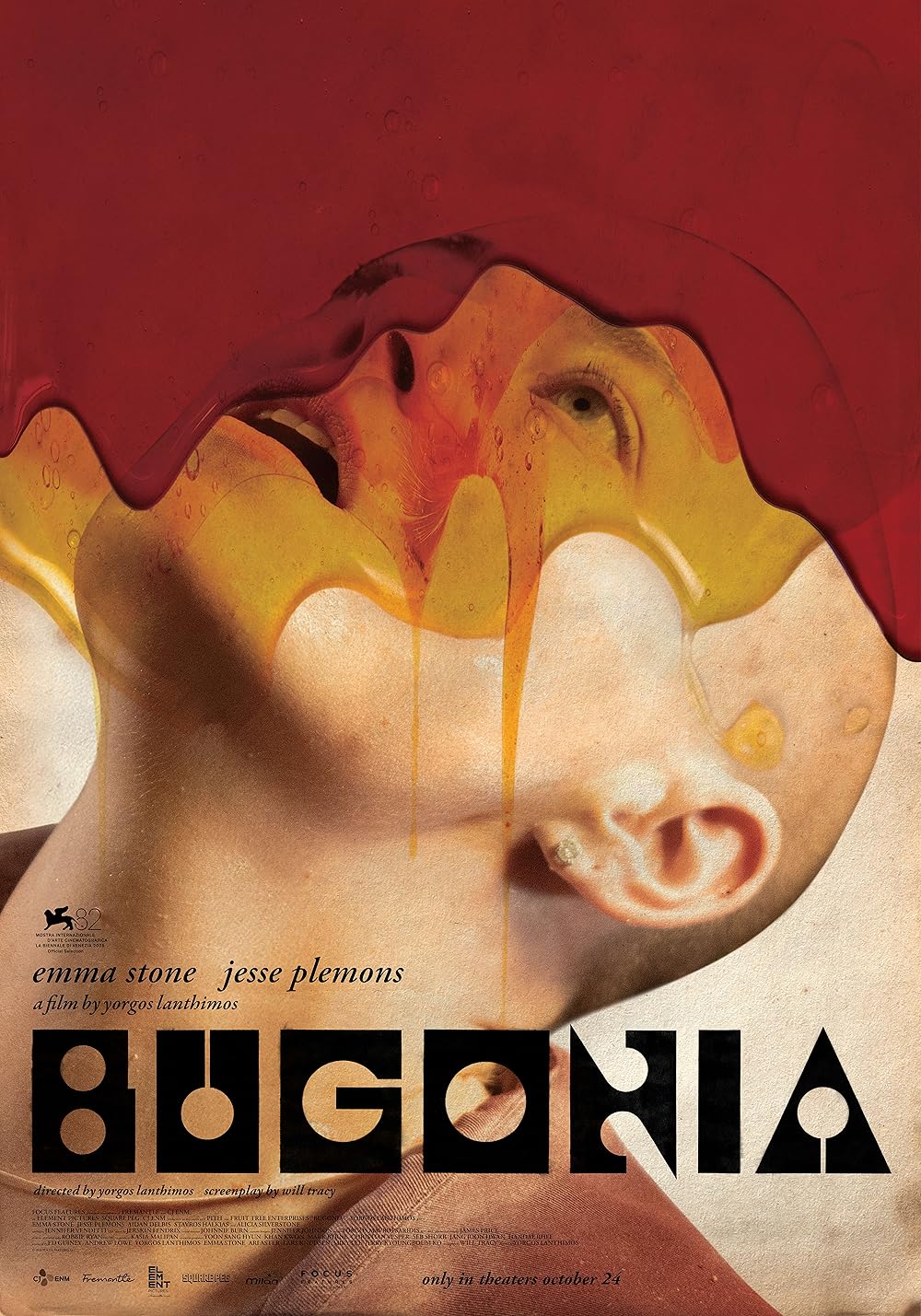
Can madness be tamed? Can paranoia become a form of faith, and faith a justification for violence? And what if, beneath layers of conspiracy-driven delusion, there really is some truth - just not the one we are ready to face? In his first remake, “Bugonia”, Yorgos Lanthimos poses these questions with a sly, cynical smile. His version of the Korean film becomes a reflection on human nature and our place in a world where everyone lives in their own isolated “hive.”
“Bugonia” is a reinterpretation of the 2003 Korean black comedy “Save the Green Planet!”. But it is also something more: a kind of dialogue Lanthimos has with himself. A story about people who have lost the ability to hear one another, about a civilization buzzing like a swarm but long stripped of inner harmony. Interestingly, for such complex themes, the director chooses not the heightened absurdist drama aesthetic (as in “Poor Things,” to which this film partly relates), but the form of a sci-fi comedic thriller.

The plot appears simple at first glance. Two provincial conspiracy theorists kidnap the head of a major pharmaceutical company. Why? Because they are convinced she is an alien who plans to destroy bees - and then humanity itself.
But what matters to Lanthimos is not the story itself, nor even its genre framework, but how belief turns into a weapon. The conspiracy theorist Teddy, played by Jesse Plemons, is an almost biblical figure: a possessed righteous man whose words sound like a prophecy of the end times. His fanaticism is both terrifying and mesmerizing. Emma Stone (the director’s longtime muse) portrays Michelle Fuller, the CEO of a megacorporation, as a being of a different nature: cold, distant, observant. In her gaze, there is both predatory sharpness and vulnerability, as if human logic does not fully apply to her.
As the title suggests, the film’s central concept is bugonia. This ancient Mediterranean ritual is brutal, yet promises purification. A bull was sacrificed, its body left under the sun, and from its decaying flesh, bees were believed to emerge - a symbol of a new cycle, rebirth, fragile harmony, and balance.
Lanthimos could not ignore such a powerful image. He weaves mythological ideas into the fabric of modernity: the disappearance of bees, ecological crisis, corporate cynicism, conspiratorial paranoia, informational echo chambers - all become stages of humanity’s collective self-sacrifice. At the center of the ritual stands Michelle Fuller, the cold core of this bloody circle, a priestess of the biotechnological age. Meanwhile, Plemons, with pastoral conviction, acts as the ritual’s guide: painfully, yet with absolute faith, he “purifies” the world, convinced he is destroying a monster.
Lanthimos’ visual language reinforces the metaphor. The mise-en-scène is constructed like ritual compositions: unusual angles and the use of fisheye distortion transform the mundane into the sacred. Every frame looks as if it were painted. “Bugonia” feels at once like an unsettling dream, a high-fashion photoshoot, and an ancient parable told through modern means. The soundtrack also emphasizes the sacred dimension: the music flows like the bugonia ritual itself, from decay to illusory rebirth, from a barely audible hum to sudden liturgical crescendos. And when, in the finale, the bees finally return to their hives, the circle closes: the sacrifice has been made.
Beneath the grotesque surface lies a living nerve. “Bugonia” is a film about the breakdown of communication, about people trapped within their own echo chambers, about a world where truth has been replaced by convenient narratives, and faith has become a form of madness. At the same time, the film clearly carries an ecological thread - anxiety over the extinction of bees and a metaphor for the moral collapse of civilization. In the middle, the film slightly loses its rhythm - a familiar weakness in Lanthimos’ work - but its ideas, intensity, energy, and visual power quickly bring the narrative back on track.
Yorgos Lanthimos once again laughs through horror and shocks through beauty. His dark comedy, with its distinct sense of humor, is a parable about belief, perception, and our tendency to invent (or discover) monsters. “Bugonia” is his latest attempt to explore human nature: a funny, unsettling, and mesmerizingly cruel “ritual” in which we are all both the victims and the ones holding the knife.